Released in 2008 for the PSP, Dissidia Final Fantasy was a watershed moment for the franchise, a fighting game that dared to unite heroes and villains from across two decades of mainline Final Fantasy titles. Unlike typical one-on-one fighters, Dissidia Final Fantasy PSP (and its 2009 sequel, Dissidia 012) created a completely different beast: real-time, three-dimensional combat that blended RPG progression with arcade-style mechanics. The game shipped with 22 characters, each with distinct playstyles, movesets, and narrative campaigns rooted in their respective games. Whether you’re returning to the game after years away or diving in for the first time, understanding Dissidia Final Fantasy PSP’s depth, from its Brave and HP attack system to its intricate equipment customization, is essential to extracting the full experience. This guide breaks down everything you need to master this cult classic.
Table of Contents
ToggleKey Takeaways
- Dissidia Final Fantasy PSP revolutionized handheld fighting games by combining real-time 3D arena combat with an innovative Brave and HP attack system that balanced accessibility for new players with depth for competitive veterans.
- The game features 22 mechanically distinct characters from across the Final Fantasy franchise, each with unique playstyles, movesets, and character-specific story campaigns that celebrate the series’ 20-year legacy.
- The Brave attack system is the core mechanic: landing strikes increases your Brave value while weakening your opponent’s, creating strategic momentum shifts that reward aggressive, forward-momentum gameplay and punish defensive stalemates.
- Mastering Dissidia Final Fantasy PSP requires understanding positioning in 3D arenas, timing Brave attack chains safely, managing stamina for movement, and learning matchup dynamics rather than relying on button-mashing.
- Equipment customization and stat growth significantly impact character viability, with endgame gear and high-level characters performing dramatically better than early-game versions, creating a meaningful progression system that rewards dedication.
- Dissidia Final Fantasy PSP proved that fighting games didn’t need complex combo systems or 50/50 mixups to be competitive; instead, clear goals, readable mechanics, and character-specific strategies could create a compelling fighting game experience.
What Is Dissidia Final Fantasy PSP?
Dissidia Final Fantasy PSP stands apart from traditional fighting games because it emphasizes position and spacing over frame data and 50/50 mixups. The core premise pits warriors and mages from Final Fantasy I through X against each other in arena-style combat. The game’s narrative weaves a multiverse conflict where Cosmos (goddess of harmony) and Chaos (god of discord) engage in an eternal battle, pulling heroes and villains into their war across dimensions.
The PSP original launched in Japan in December 2008 and hit the West in April 2009. Its sequel, Dissidia 012, expanded the roster to 34 characters and refined mechanics further, but the foundation remains consistent across both titles. The game was later ported to arcade cabinets in Japan and received a modern reimagining titled Dissidia Final Fantasy NT on PS4 and PC, though the PSP versions retain their own distinct feel and accessibility.
What made Dissidia Final Fantasy PSP special, and what keeps it beloved today, was that it wasn’t just a roster of character skins slapped onto a generic fighting engine. Each character plays with wildly different ranges, speeds, and tactical approaches. A ranged magician like Ultimecia feels nothing like a close-quarters brawler like Tifa. That design philosophy, combined with the game’s progression systems and character-specific story campaigns, created a surprisingly deep experience for a handheld title released over 15 years ago.
Core Gameplay Mechanics and Combat System
Real-Time Battle Format
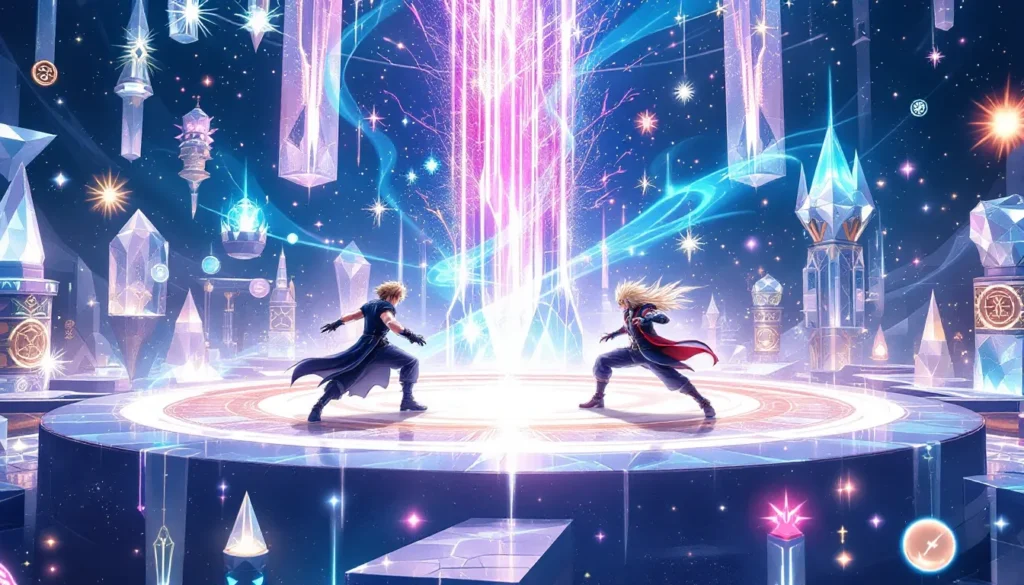
Dissidia Final Fantasy PSP operates in real-time, fully three-dimensional arenas where movement is as critical as your button inputs. You’re not locked into a traditional 2D fighting game stance, instead, you navigate a spherical arena with full control over your character’s position. This creates a chess-like layer of strategy: you’re constantly closing distance, creating space, and positioning yourself for attack opportunities.
Battles unfold 1v1, though single-player campaigns and some modes feature 1v2 scenarios. The camera orbits around the action dynamically, though players gain manual control for positioning. Movement consumes stamina, so reckless sprinting drains your resource pool quickly. This stamina management separates skilled players from button-mashers immediately.
The arena itself affects gameplay. Environmental hazards appear in certain stages, and some battlefields have topology that influences movement and attack angles. A character like Kuja, who excels at ranged attacks, gains massive advantage on open arenas, while close-range fighters like Jecht prefer cramped spaces.
Brave and HP Attacks Explained
The Brave attack system is Dissidia Final Fantasy PSP’s genius contribution to fighting game design. Instead of a simple health bar, each character has two resource pools: Brave and HP.
Brave attacks are quick strikes that don’t damage the opponent’s HP directly. Instead, they reduce the opponent’s Brave value. When you land Brave attacks, your own Brave increases. This creates an asymmetrical momentum swing: landing hits makes you stronger and your opponent weaker simultaneously.
HP attacks are the payoff. They deal direct HP damage, but you can only use them effectively when your Brave value exceeds a certain threshold. If your Brave is low and you attempt an HP attack, it deals minimal damage, making the decision to go for the finish risky. Experienced players bait opponents into low-Brave situations, then follow up with devastating HP attacks. Poor Brave management is how new players get punished hard.
The system brilliantly encourages aggressive, forward-momentum gameplay while preventing matches from becoming defensive stalemates. You must engage. You must land hits. But greed kills, pushing for a kill without sufficient Brave leaves you vulnerable to counterattacks.
Each character has 2-4 Brave attacks and 2-4 HP attacks, each with different ranges, speeds, and effects. Cloud’s Limit Break meteors play completely differently from Ultimecia’s Time Compression laser spam. Learning your character’s move set is non-negotiable.
Equipment and Ability Customization
Progressions systems in Dissidia Final Fantasy PSP go deep. Every character can equip weapons, armor, and accessories that modify their stats. You’re not just picking cosmetics, these items directly impact Brave growth, HP pool, attack power, and ability effectiveness.
Abilities are the real customization driver. Each character learns abilities through leveling and story progression. You assign these to quick-slot buttons during battles, choosing which four Brave attacks and four HP attacks you bring into combat. A defensive player might equip healing abilities, while an aggressive player stacks speed-boosting abilities and heavy-hitting moves.
Summons are purchasable or earned through progression. Equipping a summon (like Ifrit or Shiva) grants passive bonuses and a powerful one-time effect you can trigger mid-battle. Summons shift matchups significantly, choosing the right summon for your opponent’s character is part of pre-battle strategy.
Equipment rarity determines stat distribution. Rarer gear typically offers better bonuses but requires higher character levels to equip. This creates a progression curve: early-game characters feel significantly weaker than fully-equipped endgame versions. The grind is real, but intentional, it rewards dedication.
Playable Characters and Final Fantasy Representation
Heroes from Across the Series
Dissidia Final Fantasy PSP’s roster spans the franchise’s lineage. Cloud Strife (Final Fantasy VII) fights with massive swords and limit break mechanics. Squall Leonhart (Final Fantasy VIII) uses rapid gunblade combos and junction abilities. Zidane Tribal (Final Fantasy IX) employs acrobatic aerial techniques. Tidus (Final Fantasy X) leverages speed and elemental haste abilities.
Each hero feels mechanically distinct. Cloud plays as a mid-range pressure character who gradually builds momentum. Squall is a rushdown machine with incredible combo potential. Zidane excels at evasion and repositioning. Tidus combines speed with magical support abilities.
Supporting heroes include Warrior of Light (Final Fantasy I), the archetypal sword-and-shield fighter: Firion (Final Fantasy II), who uses a flexible multi-weapon system: Onion Knight (Final Fantasy III), who switches between physical and magical forms: Cecil (Final Fantasy IV), a paladin with healing utility: Bartz (Final Fantasy V), a monk who mimics enemy abilities: and Terra (Final Fantasy VI), a mage with powerful elemental magic.
Each brings signature mechanics from their original games. Cecil’s duality system (dark/light forms) translates into stance-switching mid-combat. Terra’s esper heritage grants her access to devastating magic. Bartz’s job system allows ability flexibility. The developers understood that Dissidia Final Fantasy PSP was a celebration of the franchise’s 20-year legacy, so they embedded that legacy into every moveset.
Villains and Their Unique Playstyles
The antagonist roster is equally stacked. Kefka (Final Fantasy VI) is a zoner who controls space with ranged magic and chaos effects. Sephiroth (Final Fantasy VII) wields his iconic Masamune with sweeping arcs and one-winged angel aesthetics. Ultimecia (Final Fantasy VIII) is a pure ranged character whose Time Compression attack dominates open arenas. Kuja (Final Fantasy IX) blends physical attacks with elemental ranged projectiles.
Villains typically favor different archetypes than their hero counterparts. While Cloud and Squall are physical rushdown characters, Sephiroth emphasizes range and spacing control. This design choice forces matchup variety, you can’t simply main a hero and expect the same tactics to work against their villain counterpart.
Supporting villains include Garland (Final Fantasy I), a powerhouse grappler: Emperor (Final Fantasy II), a defensive tank: Cloud of Darkness (Final Fantasy III), an aggressive close-range pusher: Golbez (Final Fantasy IV), a magic-heavy midrange character: Exdeath (Final Fantasy V), a zoner with dimension-warping abilities: Kefka (Final Fantasy VI), mentioned above: and Mateus (Final Fantasy XII), a divisive zone-control specialist.
This creates a fascinating dynamic: every hero has a natural rival villain from their game, but matchups don’t break along those lines. Hero Cloud vs. Villain Sephiroth might favor Sephiroth due to superior range, making it a skill-dependent matchup rather than a narrative one.
Game Modes and Progression Systems
Story Mode and Character-Specific Campaigns
Each of the 22 characters (in the original PSP version) has a dedicated story campaign that plays out across 10+ battles. These aren’t throwaway single-player padding, they’re narrative-driven experiences that recontextualize each character’s involvement in Cosmos’s conflict. Cloud’s campaign explores his psychological fractured state. Squall’s focuses on his resistance to being manipulated. Each campaign rewrites aspects of the original game’s plot through the lens of Dissidia’s multiverse.
Story battles ramp in difficulty. Early fights serve as tutorials, introducing game mechanics gradually. Mid-campaign battles present serious challenges, requiring understanding of Brave/HP attack timing and matchup strategy. Final campaigns against Kefka (the storyline’s ultimate antagonist) demand full mastery of your chosen character.
Rewards for completing campaigns include weapons, accessories, and ability unlocks unique to that character. New Game+ modes let you replay campaigns with higher difficulty and enhanced rewards, creating a grind loop that pulls completionists in for the long haul.
Multiplayer and Ad-Hoc Modes
For PSP owners with friends nearby, ad-hoc wireless multiplayer enables 1v1 battles. This was the lifeblood of competitive Dissidia Final Fantasy PSP play, LAN tournaments happened regularly in Japan and at gaming events worldwide.
Practice modes let you hone skills offline against AI opponents of varying difficulty settings. Training mode isolates specific matchups, letting you learn frame data (yes, Dissidia has frame data) and ability startup times. This depth attracted serious players who invested hundreds of hours mastering character minutiae.
Quest mode, unique to Dissidia 012, added a roguelike-style progression system with randomized battles and treasure chests. This mode alone added 40+ hours of content and became the go-to for casual grinders.
Leveling and Stat Growth
Character progression is straightforward but time-intensive. Characters gain experience from battles, increasing level caps up to 100. Each level provides stat increases (HP, Brave, Attack, Defense, Speed, Magical Power) and occasionally new ability unlocks.
Equipment tier gates character potential. A level 50 Cloud equipped with Iron Sword performs significantly worse than a level 100 Cloud with Ultima Weapon. This creates natural progression walls, you can’t dominate online before grinding endgame equipment and reaching higher levels.
The grind respects players’ time investment. You earn meaningful rewards frequently enough to stay engaged, but cosmetics and stat boosts never feel arbitrarily locked behind paywall mechanics (this was 2008-2009, before predatory monetization became standard in gaming). Playing is the only way forward, which paradoxically feels fair compared to modern games.
Tips for Mastering Combat and Building Winning Strategies
Character Selection and Matchups
Character selection isn’t about picking your favorite character, it’s about identifying which character beats your opponent’s matchup. Rock-paper-scissors dynamics exist here. Zidane’s evasion abilities counter aggressive rushdown characters like Squall. Ultimecia’s range dominates against close-range grapplers like Garland. Squall’s speed overcomes methodical zoners like Kefka.
Practical tip: Lab three characters. Master one primary character for consistency, but understand secondary matchups. If your main loses 70-30 against a tournament threat, you need an alternative. Top Japanese players maintained a “pocket character” specifically for bad matchups.
Your character’s learning curve matters. Cloud takes 30 minutes to grasp. Ultimecia requires understanding spacing and projectile control. Bartz demands knowledge of enemy movesets to effectively mimic abilities. Pick your learning speed accordingly.
Effective Brave Attack Timing
Brave attack timing separates gods from mortals. Mashing Brave attacks mindlessly burns stamina and leaves you vulnerable to counterattacks. Intentional Brave attack chains with proper spacing control create inevitable momentum swings.
Key principle: Safe on block, unsafe on whiff. If your Brave attack connects but gets blocked, you maintain pressure because your opponent can’t punish you immediately. If you whiff (miss completely), you’re now vulnerable to approach and punishment. This determines when to throw attacks out.
In mid-range, throw single Brave attacks to catch opponents moving forward. In close range, chain Brave attacks to maintain pressure before switching to an HP attack at high Brave. At long range, throw out attacks sparingly to avoid predictability, zoners rely on controlled projectiles, not spam.
Timing your Brave attacks around your opponent’s endlag (recovery frames) is when experienced players punish. If Ultimecia throws a Time Compression that whiffs, that’s your window to dash in and land guaranteed Brave hits while she recovers.
Item and Summon Usage in Battle
Summons are situational tools, not panic buttons. Shiva freezes opponents momentarily, useful for creating breathing room. Ifrit damages on cast, opening aggressive opportunities. Leviathan pushes opponents away, useful for escape. Odin damages and knocks down, excellent mid-combo.
Equip summons matching your playstyle. Aggressive players pick damage summons like Ifrit or Odin. Defensive players pick utility summons like Shiva or Leviathan. Understanding opponent summon picks helps anticipate their strategy.
Items are consumable pickups during battle. Potions restore HP. Ethers restore MP. Status-clearing items remove debuffs. Some characters have item-centric abilities that amplify item effects. Identify these and plan accordingly.
Meta-game insight: Japanese competitive players rarely rely on summons or items competitively. They treat the battle as pure mechanical skill. If you’re struggling with a matchup, summons won’t save you, understanding why you’re losing will. Use single-player modes to learn. Competitive play demands pure execution.
What Made Dissidia Final Fantasy PSP Revolutionary for Its Era
In 2008, fighting games were dominated by Street Fighter IV’s six-button format and Marvel vs. Capcom’s chaotic team-based gameplay. Dissidia Final Fantasy PSP arrived with a completely different philosophy: accessibility without sacrificing depth.
The Brave and HP attack system eliminated traditional fighting game gatekeeping. New players could mash buttons and still understand that “hitting opponent reduces their Brave, high Brave leads to bigger damage.” Experienced players discovered frame-perfect Brave chains, optimal summon timing, and spacing control that rewarded mastery. Both audiences found value.
Character-specific campaigns gave single-player fighters legitimacy. This wasn’t just an arcade port designed for competitive players, casual solo players had 20+ character stories to complete. The game respected everyone’s play style.
Technically, Dissidia Final Fantasy PSP proved the PSP could handle fast-paced 3D combat without sacrificing frame rate stability. Earlier 3D fighters on handheld hardware suffered from sluggish inputs and framerate inconsistency. Dissidia maintained rock-solid 60 FPS in handheld mode, a technical achievement that impressed hardware experts. Coverage from outlets like Siliconera celebrated the technical feat as much as the game design.
The roster was also radical for its era. In 2008, Final Fantasy VII was the undisputed king, Cloud appeared everywhere. Dissidia elevated characters from less-celebrated entries like Final Fantasy II and III to playable prominence. Gamers discovered that Firion and Onion Knight weren’t throwaway characters: they had deep mechanics and competitive viability. This expanded appreciation for the broader Final Fantasy canon across the gaming community.
Balance patching was unheard of for handheld fighting games in 2008. Square Enix released balance adjustments and character tweaks for Dissidia Final Fantasy PSP in Japan, setting precedent for ongoing post-release support that’s standard today. The RPG Site and other gaming outlets documented these balance shifts as they happened, tracking which characters rose or fell in tier rankings with each patch.
Competitively, Dissidia Final Fantasy PSP spawned regional tournaments in Japan that lasted for years. The game proved that handheld fighters could support legitimate competitive play with prize pools and sponsorships. This legitimacy attracted serious players and elevated the game’s cultural status beyond casual fun.
When compared against modern fighting games like Street Fighter 6 or Tekken 8, Dissidia Final Fantasy PSP’s design philosophy, accessibility married to mechanical depth, appears prescient. It understood that fighting games didn’t need 200-frame combo routes and 50/50 mixups to be compelling. They needed clear goals, readable mechanics, and character-specific strategies. Gematsu and other Japanese gaming media covered Dissidia’s emergence as a fighting game alternative for players interested in story-driven experiences alongside competitive play.
The game’s legacy is also tied to what it represented: proof that Final Fantasy, traditionally an RPG franchise, could successfully translate into other genres without losing its soul. The characters felt authentic because their mechanics mirrored their narrative roles. Cloud was a directionless swordsman in gameplay just as he was in FF7. Ultimecia’s time-warping abilities reflected her story significance. This character-mechanics synergy remains the franchise’s strongest asset.
Conclusion
Dissidia Final Fantasy PSP remains a singular entry in both the Final Fantasy franchise and handheld fighting game canon. Its Brave and HP attack system brilliantly balanced accessibility with depth. Its roster celebrated the franchise’s history while delivering mechanically distinct playstyles. Its progression systems, character campaigns, equipment customization, and stat growth, gave solo players 100+ hours of content.
Whether you’re returning to the PSP original or discovering Dissidia for the first time, understanding these core systems transforms casual button-mashing into strategic gameplay. Master Brave attack timing. Lab character matchups. Understand your equipment options. These fundamentals separate competent players from legends.
The game sold over 2 million copies worldwide and spawned a direct sequel, arcade ports, and eventually a modern PS4/PC reimagining, but the PSP original remains the most beloved entry among dedicated fans. It’s a snapshot of early 2000s JRPG ambition meeting fighting game innovation, a moment when anything felt possible in gaming. That spirit, preserved in every battle, is why Dissidia Final Fantasy PSP endures.


